UNIVERSE REPORTING
Reduced multi-ticket edit time by 90% for enterprise event organizers through bulk editing tools
Enterprise event teams were spending hours manually updating ticket types. I designed a bulk-editing system that automated those updates, cutting operational time and saving clients hundreds of hours per month.
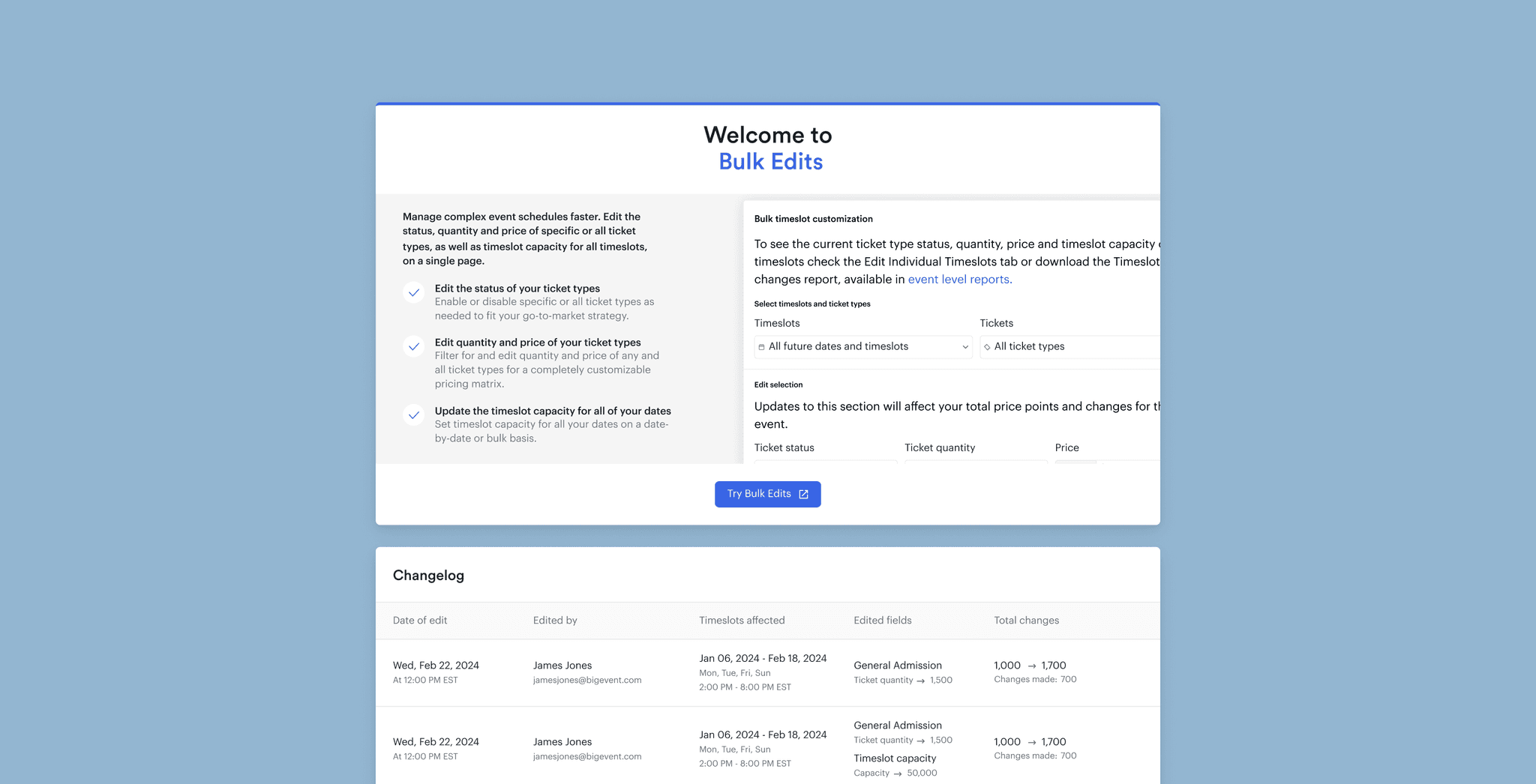
WHY THIS MATTERED
Universe clients were losing revenue.
Enterprise clients running long events wasted hours fixing hundreds of time slots manually, leading to errors, operational overhead, and churn risk. Without scalable bulk-editing, we could not retain or win enterprise contracts.
KEY RESULTS
Speed
Ticket update times went from 5hrs to 10 minutes (90% improvement).
Schedules
Automated ticket activation, removing after-hours work and manual edits.
Scale
Solution became the foundation for future features.
Revenue
Business saw enough value to make it a paid feature, increasing revenue.
ROLE
Lead Product Designer
TIMELINE
6 months
TEAM
Product Manager
Developers
PROCESS
User journeys | Interviews
Persona definition | CSD Matrix
Usability testing | Iterations
SKILLS
End-to-end Product Design
Preliminary building
Hands-on shipping
WHAT I OWNED
Discovery, validation, and delivery
I owned the end-to-end product work. I defined the problem with my PM, validated solutions through rapid prototyping, partnered with engineering to scope and de-risk the system, and led user testing and rollout. I also assisted in formalizing components and flows in Storybook to enable future development at scale.
PROBLEM
Bulk editing didn't exist, and clients were becoming frustrated
PIVOTING FROM INDIVIDUAL EDITS
Universe was trying to optimize for individual ticket and timeslot edits, but no update tackled our client's actual pain points.
I advocated for conversations with our internal teams and the timed entry clients that used this feature, and learned that editing in bulk should span our entire product offering. We started with ticket and timeslot edits as that was where pain points were the most pronounced.
BEFORE
Restricted by one action at a time.
Organizers had to update every ticket and time slot one by one, turning large events into hours of error-prone manual work and creating operational strain, delays, and churn risk as event complexity grew.
AFTER
Unlocked tickets and timeslots
Bulk editing let organizers update tickets and timeslots themselves, eliminating repetitive support work and freeing internal teams to focus on revenue-driving priorities.
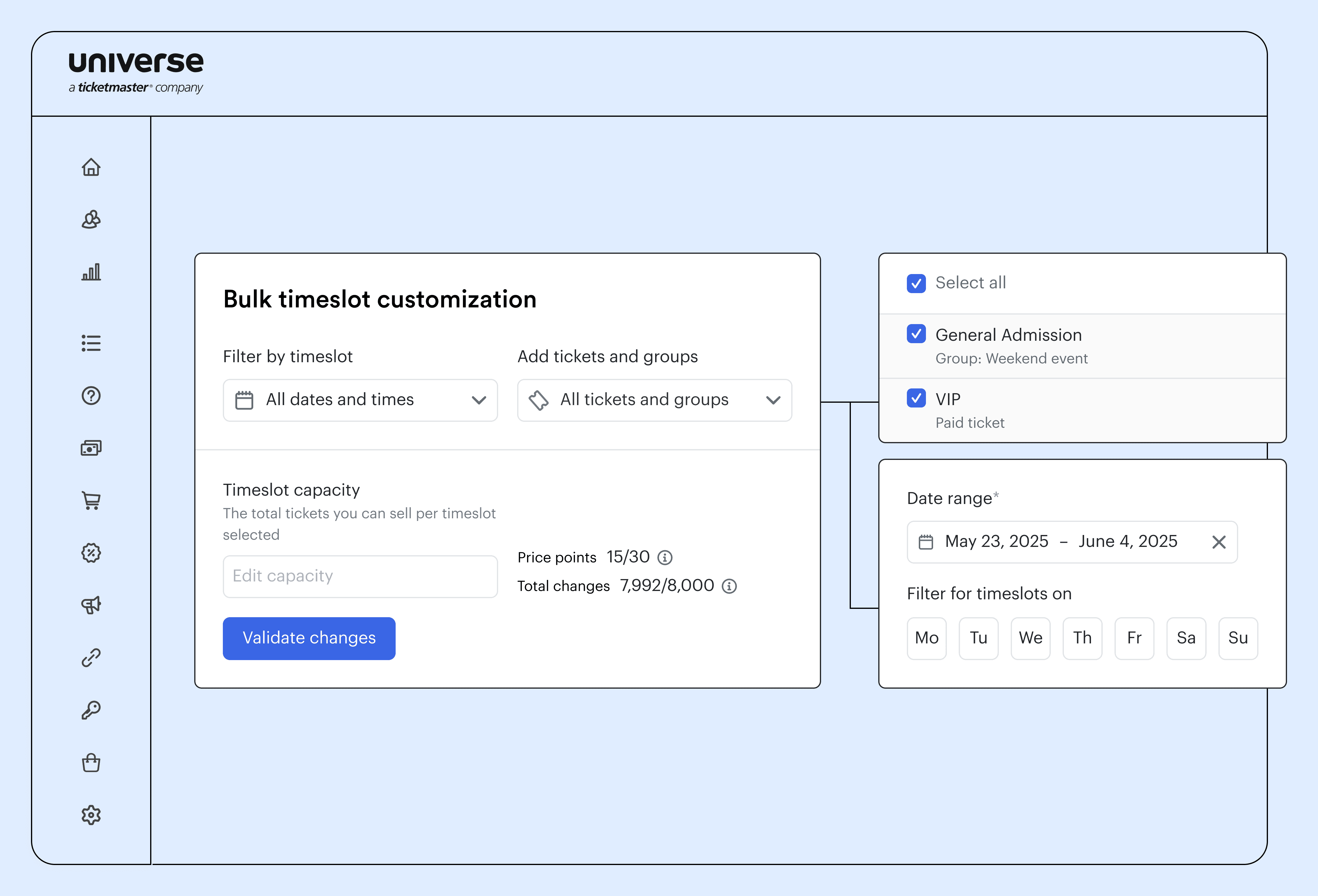
A more focused experience
Turned a messy, multi-step workflow into a focused guided flow, driving >85% task success in under one minute for high-volume enterprise events.
Tracked changes
Added a changelog so operators could see who edited what and when, improving accountability and speeding up issue resolution.
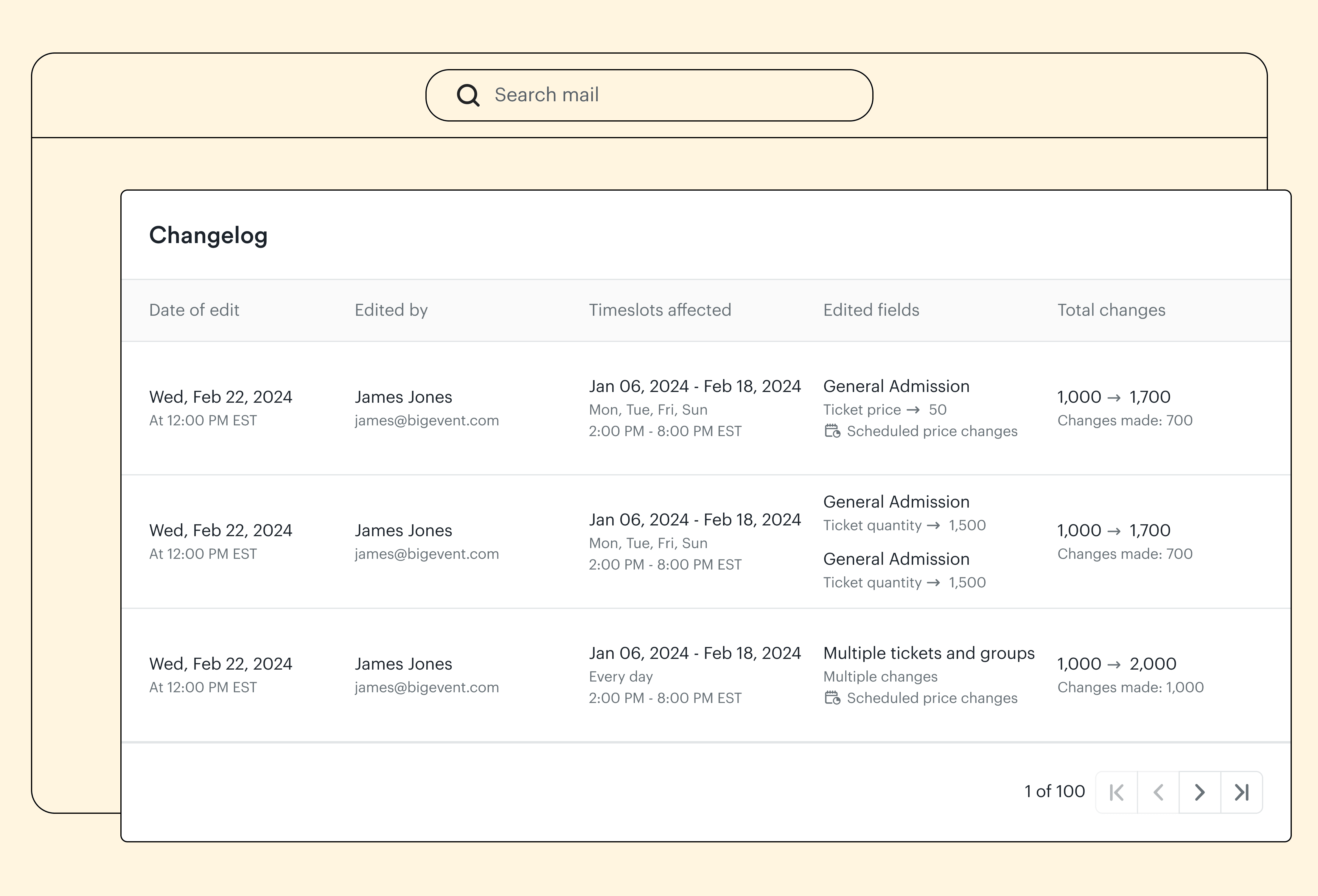
DISCOVERY
Establishing scope.
CONVERSATIONS AND COMPETITORS
Set out to understand how enterprise customers managed high-volume events and where current workflows broke down. These conversations surfaced critical needs around auditability, automation, and scalability.
Competitive analysis confirmed that bulk editing for complex ticket structures was still emerging in the market, positioning this as an opportunity to strengthen Universe’s enterprise advantage and expand beyond existing ticketing patterns.
APPROACH
MVP and process
START WITH SAME EDITS ACROSS MULTIPLE SELECTIONS
We decided on an iterative release to test with users along the way, starting with selecting the tickets and timeslots users wanted to edit and actioning the same price, quantity, and capacity for each.
RESEARCH TOOLS
We mapped our user stories into an impact matrix to determine what was high impact and minimal effort, then prioritized pain points in a matrix to see how often problems appeared and how important they were, all to identify our testing milestones.
FEASIBILITY
Performance was our biggest blocker.
TIMESLOT CHANGES LIMIT
The system could only handle a few ticket changes at once, so I worked with engineering to establish safe limits and designed flows that operated within them while performance improvements rolled out.
ALLOW INDIVIDUAL EDITS
I prioritized shipping bulk edits fast while keeping the legacy flow, and designed the new version to support a future unified experience when operational and technical conditions allowed.
ITERATIONS
Critial decisions & tradeoffs.
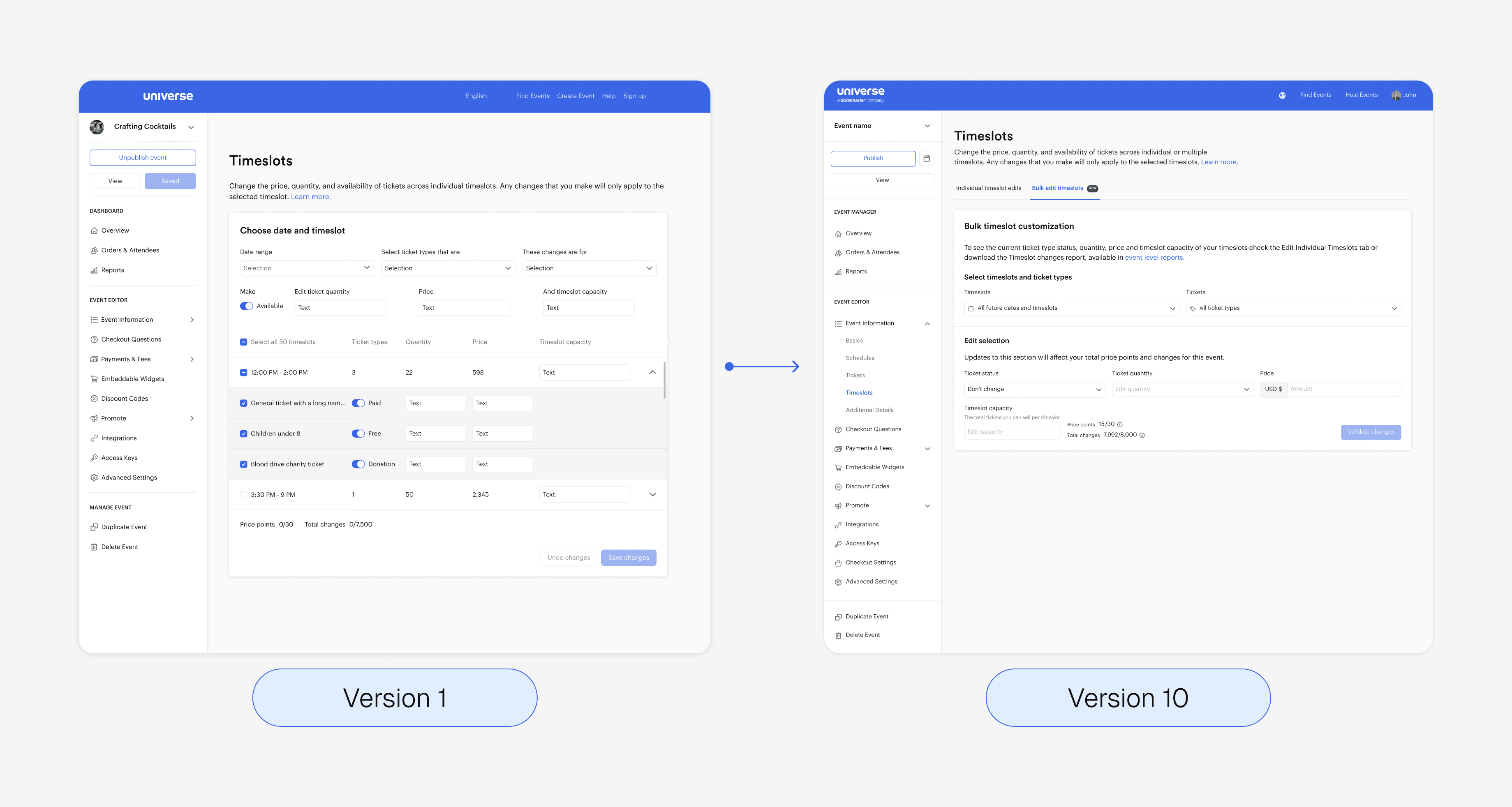
VERSION 1-10
We tested table-based bulk edit concepts in high fidelity, hit performance limits fast, and pivoted to a simpler interaction model that kept enterprise editing performant.
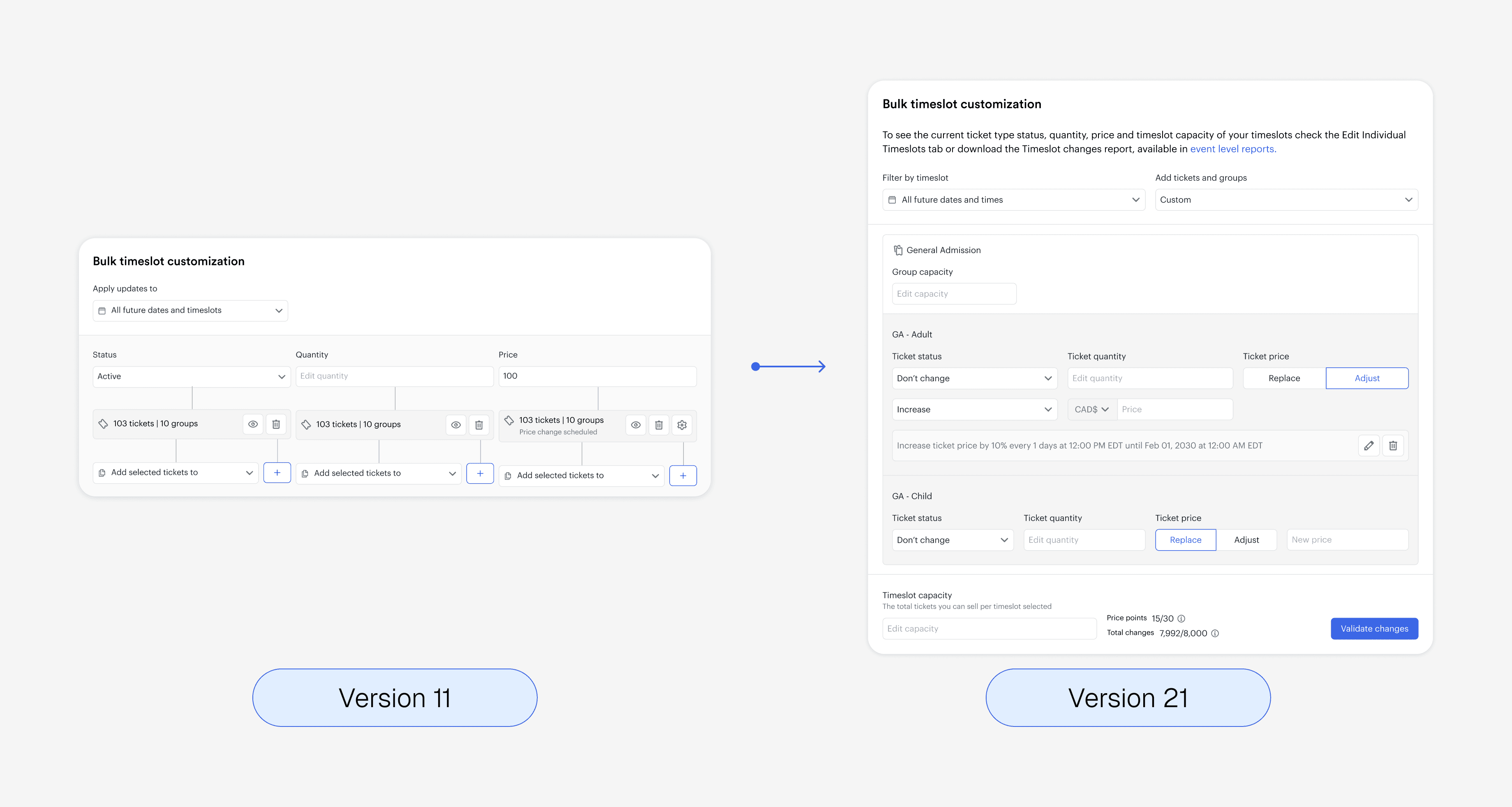
VERSION 11-21
As scope grew, I refined the flow to show only the controls needed at each step, resolving early ambiguity around selection targets and enabling confident high-volume edits across complex ticket structures.
SUCCESS METRICS
What to track, and how to track it.
Our main OKR was to reduce time spent by timed entry hosts customizing their event schedule, from 5 hours to 30 minutes. We got it down to 10 minutes on average.
Our KPI was tracking adoption by 5% from new timed entry events that were, on average, 6 months long, measured by the number of events that action >1 bulk edit. We got to 13% adoption.
We would track origin of customizations actioned via bulk edits, the user, event type, and number of edits made in our application tracking software.
BUILD
Hands-on shipping process
Partnered tightly with engineering to scope and sequence milestones, shipping value incrementally rather than waiting for a full release. Coordinated early testing with customer success and design to validate workflows in real conditions and tighten feedback loops.
TESTING INSIGHTS
Validating with clients before launch.
INFORMATION OVERLOAD
Internal teams flagged the ambiguity that arised from seeing too many options at once. We went from surfacing every editing field in the same view to simplifying the UI for better comprehension and performance.
ENHANCED COMMUNICATION
Previously, when a user made a custom selection to timeslots and ticket types, we would label the respective fields as "Custom". We saw how important it was to be explicit about selections made, as users found they had to recall their selections manually, slowing down critical actions.
SEPARATING GROUPS FROM INDIVIDUAL TICKETS
We started with allowing edits to ticket groups and invidual tickets in the same container, but it wasn't immediately clear to our users which edits would apply where, signaling me to update the structure by separating the two and surfacing dedicated edit fields for each.
SOLUTION
An iterative release strategy.
Released bulk editing incrementally to validate performance, adoption, and usability in real production environments. Each milestone delivered functional value while tightening feedback loops with enterprise users. The feature surpassed adoption targets, drove measurable operational savings, and reduced support load across high-volume accounts.
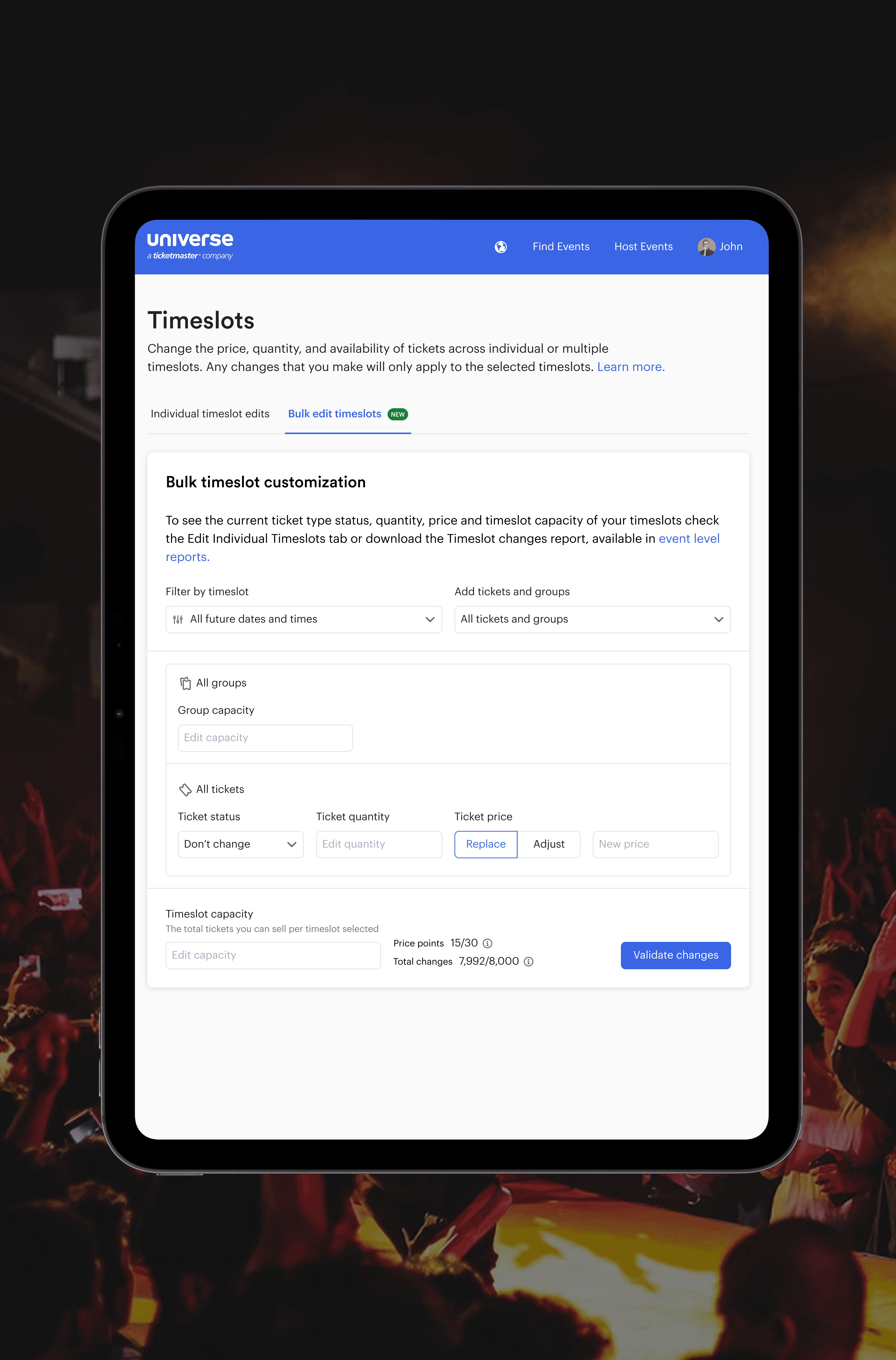
FIRST MILESTONE
Launched a focused first version that enabled consistent edits across tickets and timeslots, delivering immediate efficiency gains while validating the interaction model before scaling to more complex cases.
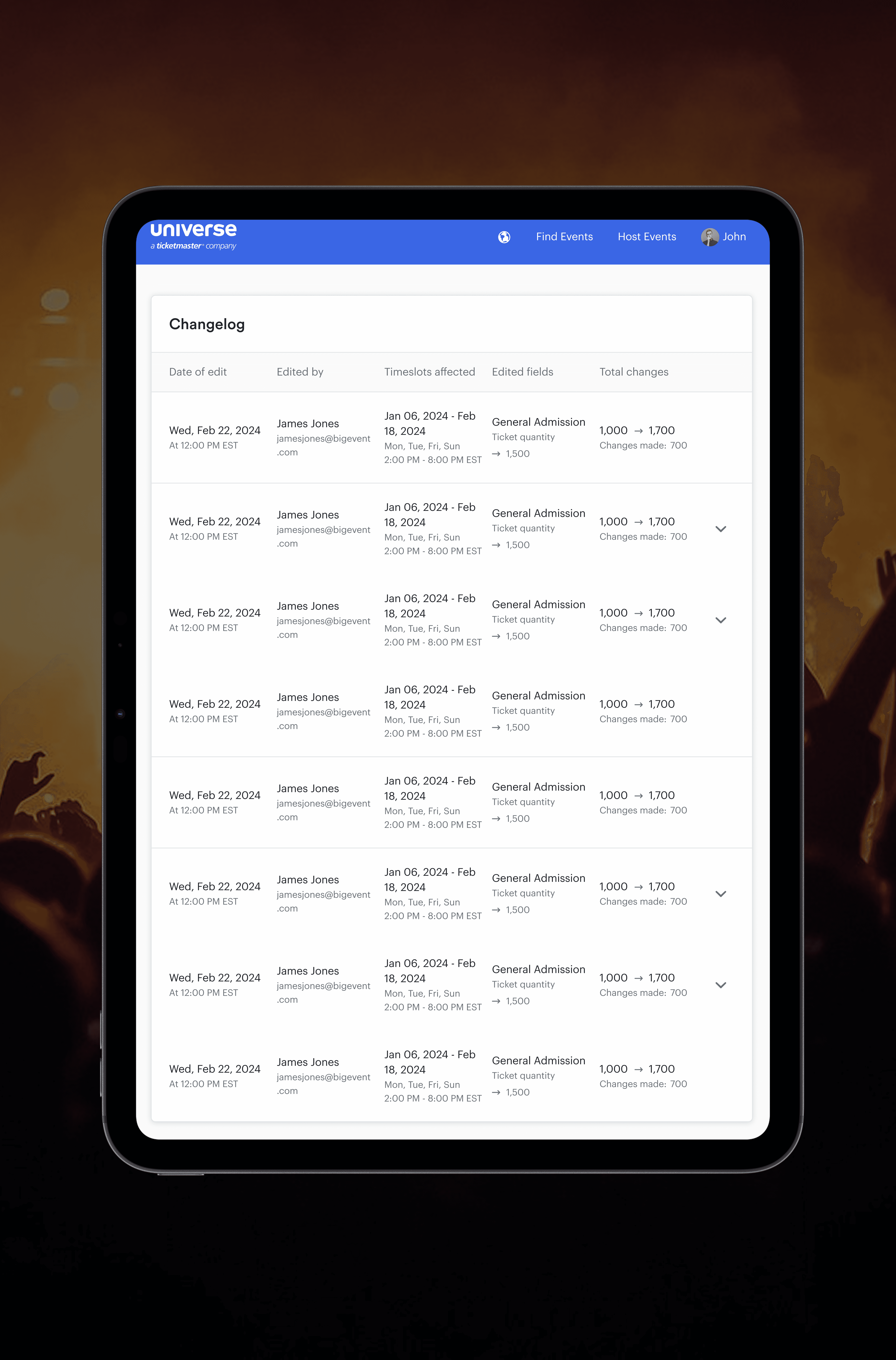
TRACK CHANGES
Added change tracking so teams could see who made edits and when, eliminating manual logging and strengthening accountability on high-volume events.
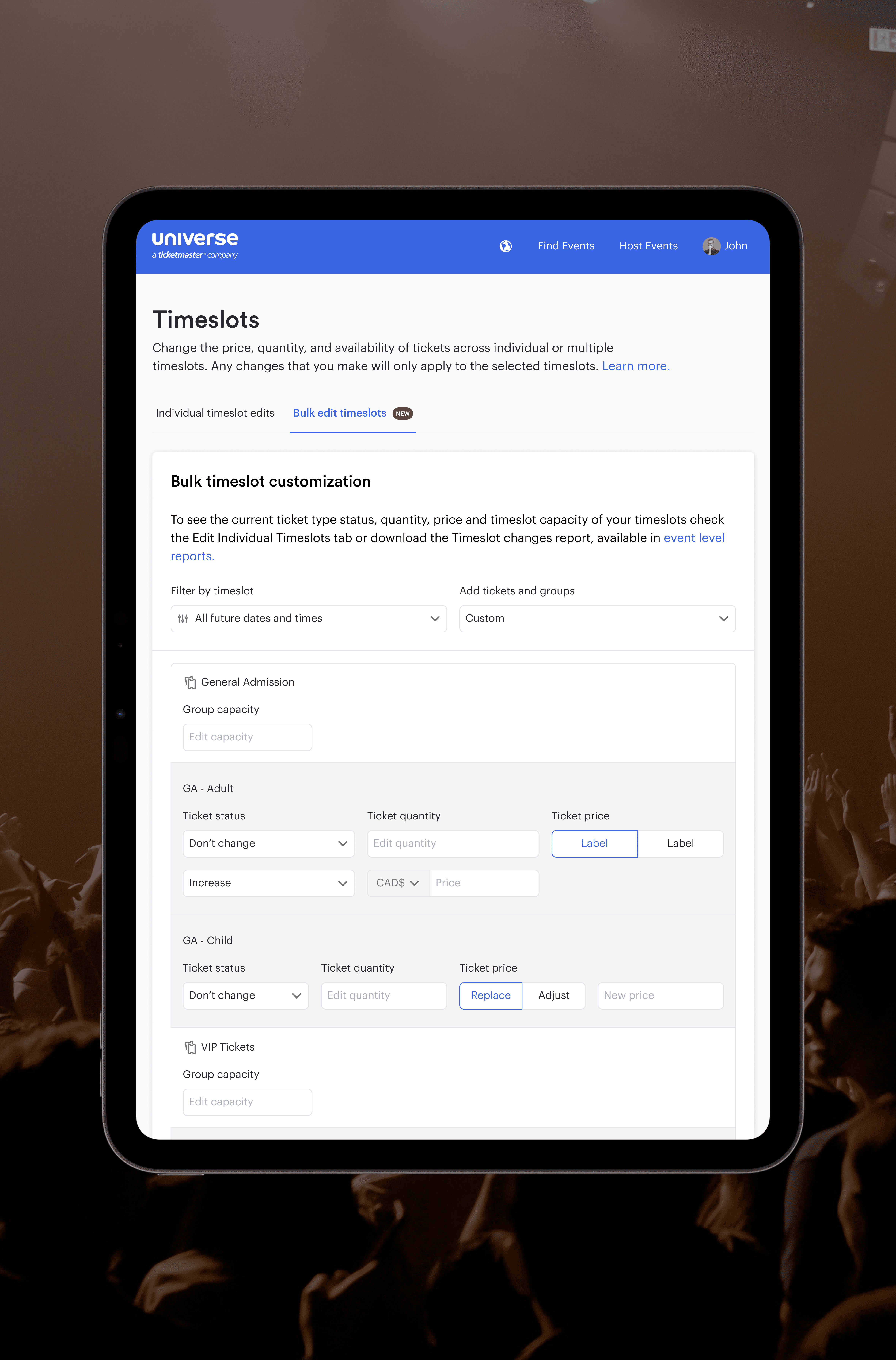
EXPAND FEATURES
Expanded bulk editing to support complex ticket groups and multiple edit types in one flow, letting organizers update large events quickly without jumping between tools.
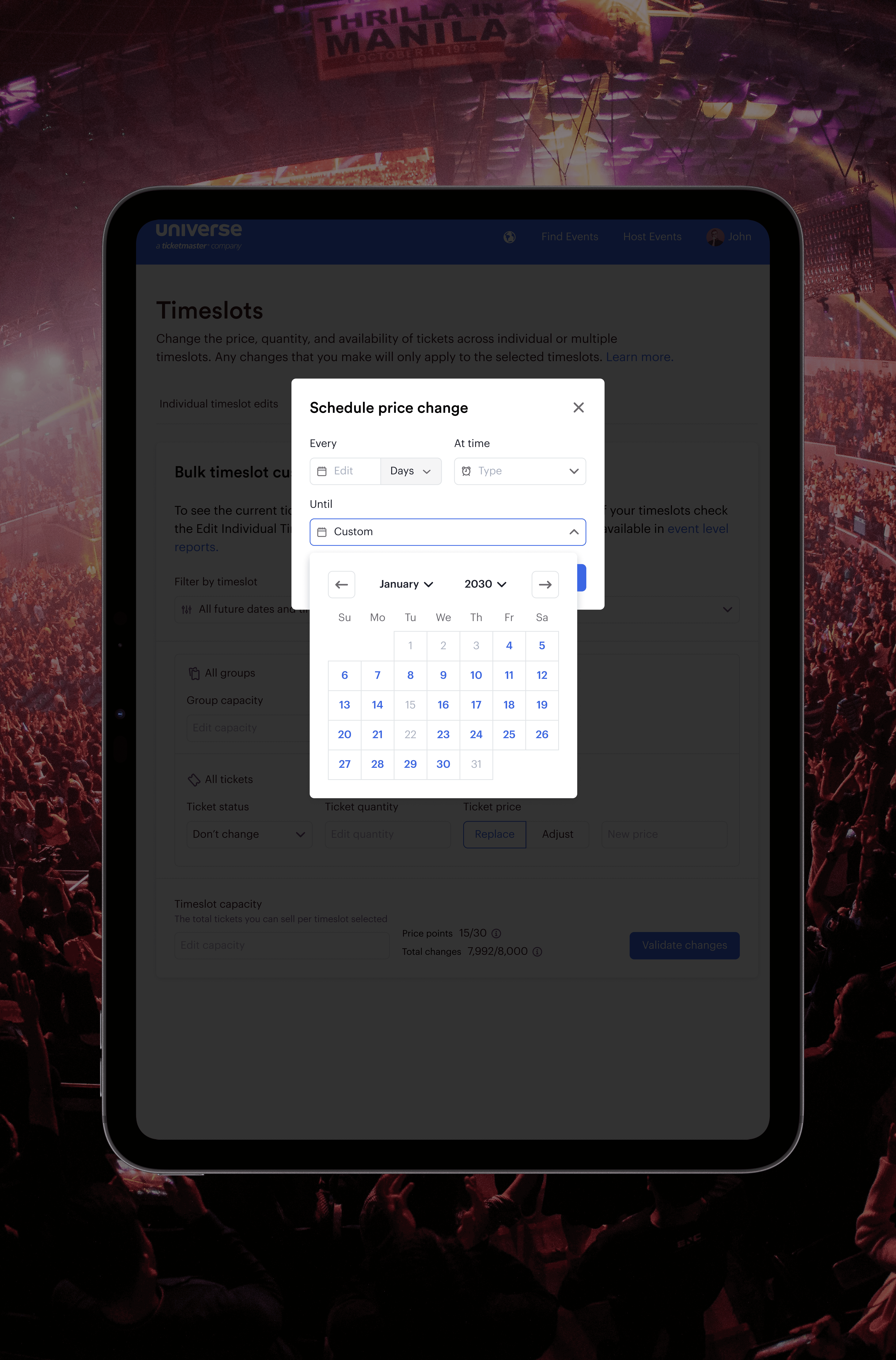
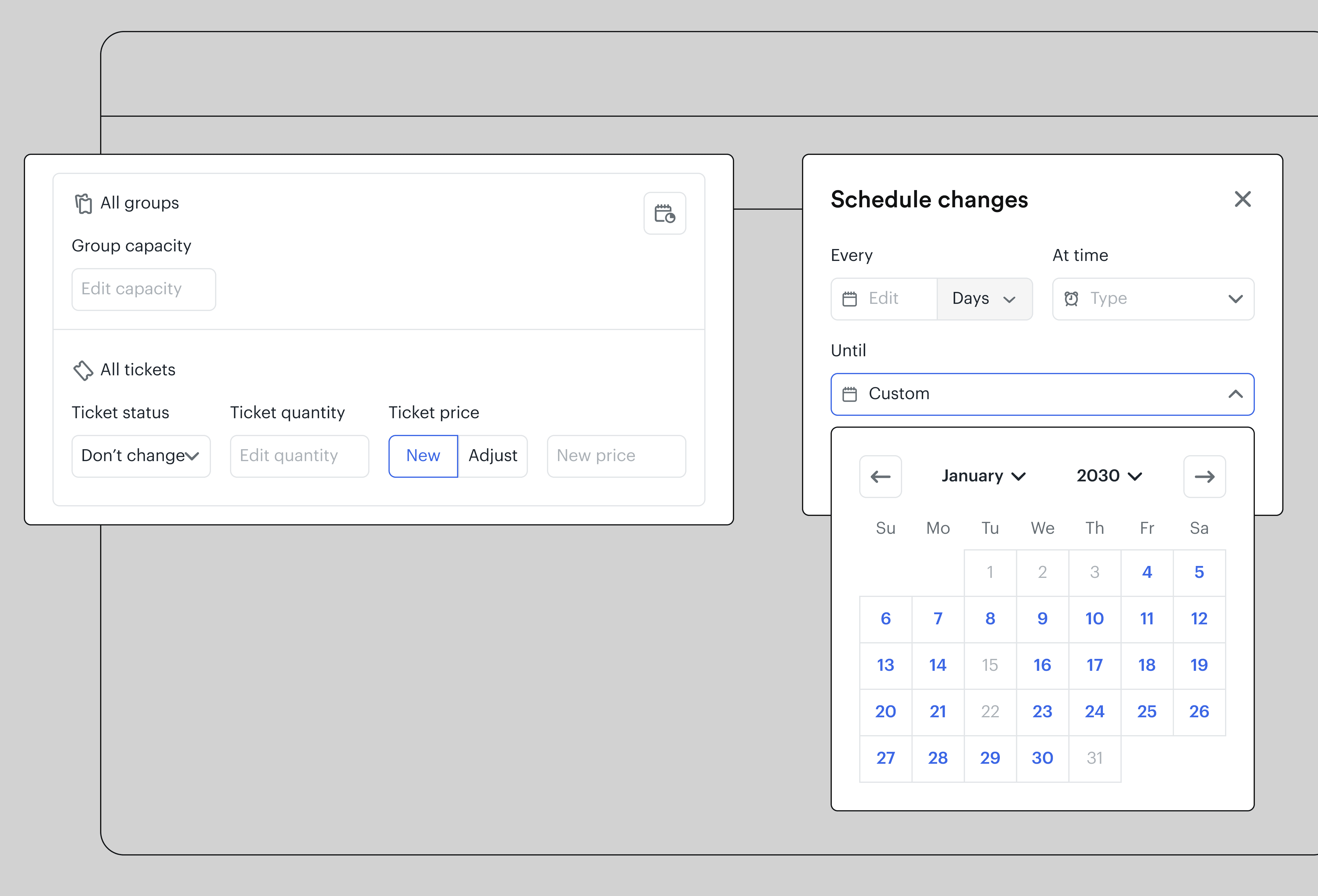
AUTOMATE EDITS
Enabled scheduled bulk edits so teams could roll out changes automatically during business hours, eliminating overnight manual work and reducing staffing costs.
IMPACT
" height="20px" id="uxdlBAd7X" width="20px"/></svg>)
" height="15px" id="xlSDvxJt3" transform="translate(0 1.685)" width="20px"/></svg>)
" height="20px" id="AqGU0CTSh" width="20px"/></svg>)
REFLECTION
What I learned and would do differently.
This project made it clear that waiting for direction slows impact. Early on, I deferred to others instead of driving discovery and challenging assumptions myself. As the work expanded, that hesitation compressed my runway for research and iteration, which forced urgency but limited strategic depth.
I changed that approach. Positive outcomes showed that sound instincts and fast execution are not enough. Since this project, I have leaned into shaping problem spaces earlier, pushing clarity up front, and owning momentum rather than waiting for it. That shift has made me a more assertive, forward-driving product designer.